
Martin Scott
1788-1847
 |
| DIRECTIONS |
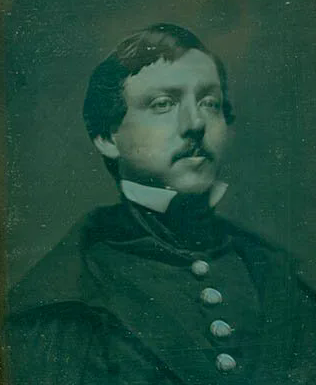
Martin Scott was born in Bennington in 1788. He enlisted in the "Green Mountain Boys" when the War of 1812 broke out. He left the service after the war but reentered the army in 1814. In 1828, now a captain, he represented the U.S. Army at the signing of the Treaty of St. Peters with the Ojibwa tribes.
Captain Scott spent much of his career at frontier posts in the Northwest. Joseph LeConte met him when Scott commanded Fort Mackinac and stated that "he was an interesting man, with strong, alert, athletic figure, bright, eager, keen grey eyes, and ruddy face, bronzed by long exposure. He was a great disciplinarian, and the fort was clean and orderly in the extreme."
Scott was best known as a marksman and a hunter. He killed his first bear at the age of twelve, and by the 1820's had a reputation for being the best shot in the military. A common phrase of the period was "Martin Scott's coon," referring to an oft-repeated story about a raccoon who simply "gave himself up" when it discovered who it was being hunted by. He married late, as hunting sports was his first passion. He always had a good horse, a pack of hunting dogs, and a servant to care for them.
Scott was detested by the other officers. He was uneducated and thought stingy, though he never told anyone that he sent much of his paycheck to his mother and sister in Vermont. Worse yet, he did not drink, smoke or gamble and so was labeled anti-social. The snubbing eventually provoked Scott to challenge the next person to insult him to a duel.
The officers found a willing antagonist in a lieutenant named Keith, and the duel was set. Both men fired, Keith being shot through the chest and Scott through the bowels. Both men survived, but apparently no one dared provoke Scott after this incident.
There was never any question about Martin Scott's bravery. He was brevetted from Major to Lieutenant Colonel for gallant and meritorious conduct at Monterey. In 1847, at the battle of Molino del Rey, he was warned to be more careful of the bullets, but must not have heeded the advice, as he shortly fell from his horse with a bullet through the heart.
Colonel Scott's body was returned from Mexico and a lavish military funeral was held here in Bennington with over 5,000 people attending.
